

'AAA' Review
How Hyukoh, Sunset Rollercoaster and Na Kim search for a universal song

The Korean indie-band Hyukoh has been garnering steady attention over the years and in July last year they released quite a special project with the Taiwanese band Sunset Rollercoaster. The album titled ‘AAA’ has struck me with some interesting thoughts on the universal within Modernism and just how art speaks to different cultures. Additionally, the album design by Korean designer and artist Na Kim, links the project to a trajectory of graphic communication that comes uniquely from a globalized design culture. Let me unpack this.
Hyukoh is a four member band fronted by Oh Hyuk who has been a stable part of the growing indie band and singer songwriter scene in Korea since the debut album ‘20’ in 2014. In addition to the mellow sounds of his singing and the talented instrumentation of his bandmates, Oh Hyuk has masterfully crafted his brand image and steadily built a cultural notoriety amongst Seoul hipsters. He is affiliated with several Korean fashion brands, espeically the fashion project 다다DADA多多 Service. This may be linked to his studies at Hongik University, where he enrolled after spending most of his life living abroad in China due to his father’s scholarly and ministerial career.
Despite Oh’s ability to speak a bit of Mandarian, the communication between him and Sunset Rollercoaster frontman Kuo resonates on a deeper level, which can be heard in the lyrics and songs of ‘AAA’. When I first listened to the album, it affirmed my growing respect and interest in the indie bands of Korea. Bands like Meaningful Stone (김뜻똘), Se So Neon (새소년) and Silica Gel play very well, but more importantly they have cultivated their sense of taste with a level of connoisseurship reminiscent of Shibuya-kei acts (I recommend this video to brush up on the hipster revivalism associated with the Tokyo scene).
Sunset Rollercoaster and Hyukoh share this sense of musical taste making and genre bending. Sunset Rollercoaster may be more obvious in this pursuit as past albums like ‘Bossa Nova’ and ‘Cassa Nova’ have a decidedly retro stylistic bent. I think some of the attraction to Hyukoh from abroad is that their sound is not as heavily rooted in Western rock standards. Rather, Oh Hyuk’s singing style is quite Korean, in the sense that he borrows progressions that can be easily found in Korean ballad singers. Also, I think that Hyukoh brings a level of dramatic orchestration in both Oh Hyuk’s singing as well as the band’s compositions, which can be felt strongly across the tracks on ‘23’.
Listening back on ‘AAA’ with a perspective of influences and tastes, the album’s uniqueness is reinforced, which brings me to the central idea that I’d like to pursue in this review; the albums possesses an expression of artistic universalism through negotiated experience. What do I mean by this? Well, I think that the concerted collaboration at work in ‘AAA’ is about two artists navigating their musical tastes, artistic expressions and cultural languages to create an album of songs that search for this very contract of communication. Kuo and Oh are searching for the same thing, a beautiful song. They both use their respective lived experiences and the various tools at their disposal to find this within each other. From the title track ‘Kite War’ there’s a longing and searching through both verse and instrumentation (this is where the saxophone wails sound like a hunt for something in the mountains). To me, there is an overall sense of discovery that is the primary motivation that drives the songs on ‘AAA’.
Another negotiation at play in the album can be found within the lyrics. Although most of the album are composed in English and all song titles are in that “shared” language, Oh Hyuk brings several Korean verses on tracks like ‘Young Man’ and the lyrics of ‘Antenna’ are all in Mandarin. The result is an album where the voices transcend language and Kuo and Oh’s lyrics are bound by their respective sonic renditions, more than linguistic expression. To me, this gives the project a universalist intent and reveals a yearning for human understanding that’s tied together by a deeper communication. Across the album the two bands play back and forth, singing in English, Korean and Mandarin,
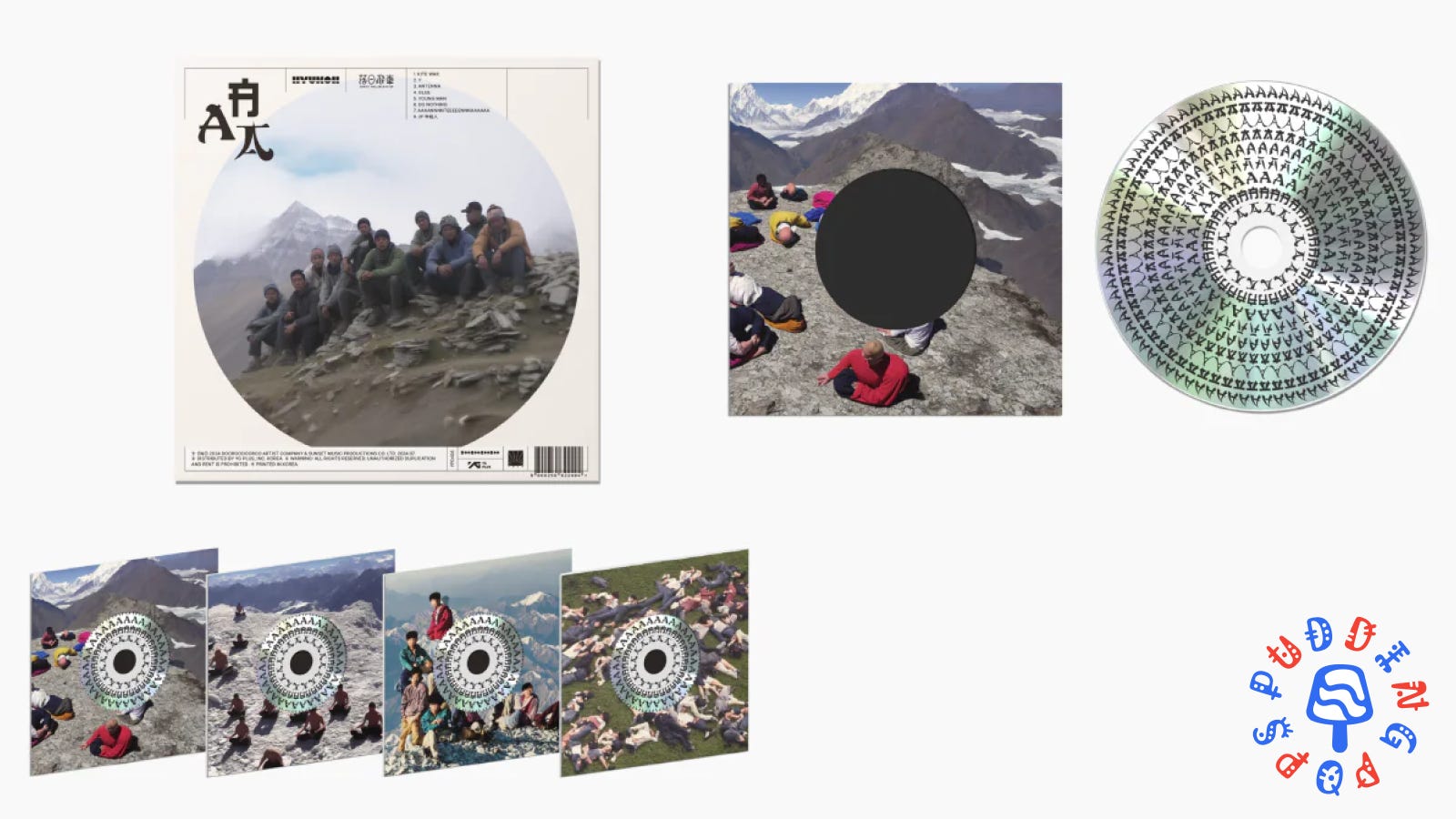
The theme of discovery and a traveling journey is communicated in the album cover art as well. The album was designed by Na Kim in collaboration with Chanhee Hong (홍찬희) of the creative collective Balming Tiger. Hong utilized AI to generate images of the band members on a journey up in the frosty peaks of a mountainous landscape indicative of Nepal or Tibet. The imagery in itself is striking, due both to the journeymen story and the AI generated technique, but the profound design element of the design lies in the typography of the title ‘AAA’. Kim designed a “logo” of three different ‘A’s from “oriental” typefaces. Kim, in an Instagram post, explains the back story of the design, revealing an experience of when she was first studying and working abroad in the Netherlands. I’ll return to this personal explanation, which is increasingly rare for Kim in her presentation of her works, after a brief analysis of Kim’s oeuvre.
Na Kim has been one of the most recognized and celebrated contemporary graphic designers. She also happens to be Korean. She has been deft in her ability to position her work to an international audience, not only through her presentation, but also her thematic explorations. To me, Kim has always possessed a unique take on Modernism in her search for an elemental graphic language. Her on going series Set is a meditative exercise in finding the universal primary language of sign and shape embedded within our industrially produced environment. At times, her work has appeared post-modern in method i.e. her attraction to patterns, but I believe she’s always been firmly rooted in a Modernist stance. In her consistent search and utilization of primary graphic form and her conceptual explorations of time, rhythm, measure and composition there always is a search for something elementary, primary, but ultimately constructed as opposed to primal or organic. In this respect, Kim’s work has always held a strong level of constraint in pursuit of creating order in an otherwise chaotic world where systems fail and standardization flattens.
So, given this context from which Kim has worked, it was quite surprising to read her description of the design for ‘AAA’. In the caption of the IG post, Kim reveals the initial conversations she had with Oh Hyuk about ‘Asian-ness’ and recounts one of her early experiences in the Netherlands, encountering the typeface Mandarin on Chinese restaurant signs. The typeface drawn to appear like ink brush strokes was published by the Cleveland Type Foundry in 1883 and was originally named “Chinese”. Over her travels she came to see that the typographic use of Mandarian was not limited to the Netherlands and that throughout the world the depiction of Asianess was tied to typefaces like Last Ninja, Samurai, Gang of Three, Of Maids and Men, Kato, Bonzai, All Yoko; all drawn by non-Asian designers. She recounts her frustration and confusion as to why Asianess was limited to these typefaces and only being able to order fried rice or wonton soup, despite knowing the bountiful range and diversity of Asianess in the rest of the world.
I asked Kim over email about how ‘AAA’ fits within her work and she shared how her process is motivated by a search within the material she’s given. She related “when I work on a design project, I often take cues from the structure I'm given, and I find it satisfying when the clues I find along the way connect to past memories to create something personal and unique”. For me, the design that appears on ‘AAA’ carries her trademark use of pattern and form, with a heavier and deeper lived experience that elevates the conceptual terrain that Kim usually explores. In this respect, her design affirms that the “personal is political” and that in the artists’ search for ideals and Modernity, lies a deeply personal expression shaped by the contradictions of globalized culture.
In my interpretation, Kim has long used abstraction in to bring a level of universal understanding. As her work has transition more into the fine art realm, the personal narratives and stories that she works out through primary shapes, colors and forms recede and invite individual interpretations. When asked about universality in her work she shared “I think that a lot of times, because these environments are often mediated by everyday and familiar objects, the work that goes through this process is often taken as a universal image. But in the end, I think that interpretation is a layer … I've always been interested in very personal narratives and layers of memory, and I'm intrigued by the idea of creating a device that can translate them into a more objective metric”.
I am familiar with the conceptual tension that Kim enjoys exploring between the subjective world and objective method, but her work on ‘AAA’ struck me more profoundly because of her reveal of the specific experiences that brought forth the design. This type of specificity within the universal, I think, is the way to make Modernism relevant and profound again in an increasingly cynical and disorderly world.